
Man Ray: Return to the Dream by Errika Deli
Man Ray: Return to the Dream is a visual exploration of Man Ray’s experimental cinema through the creation of three analog collages. Drawing inspiration from four films produced between 1920 and 1929 -Return to Reason (1923), Emak-Bakia (1926), The Starfish (1928), and The Mysteries of the Château of Dice (1929)- the project approaches his cinematic practice as a field in which linear narrative is dismantled and visual experience rearticulated.
The title of the project is directly derived from the film Return to Reason (1923). Here, the notion of “return” operates ironically, pointing to the artist’s break from the rational structure of cinematic representation. The work draws upon the “logic” of the dream, where discontinuity, free association, and fragmentation form an alternative mode of meaning. At the same time, the practice of automatism, as articulated by André Breton, serves as a methodological foundation, allowing the compositions to unfold beyond the control of conscious intention.
The collages are constructed through the assemblage of fragmented images, generating a form of visual “noise” that evokes the fluidity of the oneiric experience. The female figure appears as an elusive presence -not as a fixed identity, but as a trace of desire and imaginary projection. Eroticism remains suggestive, “concealed even at the moment it reveals itself,” as noted by Georges Bataille.
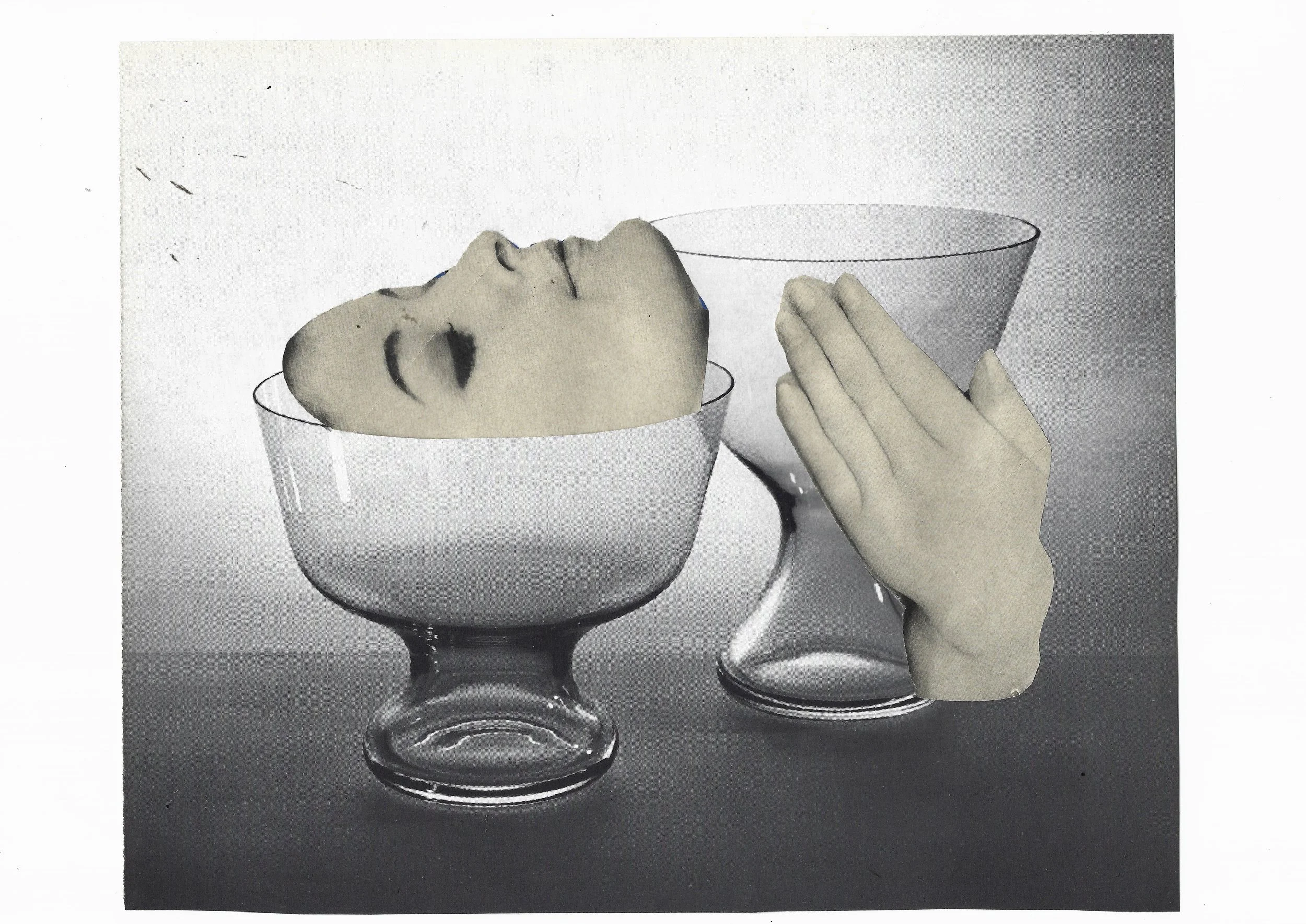
Νο.1
This collage draws inspiration from the Dadaist and Surrealist aesthetics of Man Ray’s films Emak-Bakia (1926) and The Starfish (1928). By positioning the female face within the cradle of a glass vessel, supported by an intimate gesture of clasped hands, the work softens the "uncanny" nature of the surrealist object. The composition does not merely deconstruct the body; it shelters it, creating a sanctuary that bridges the gap between mechanical surrealist detachment and human affection.
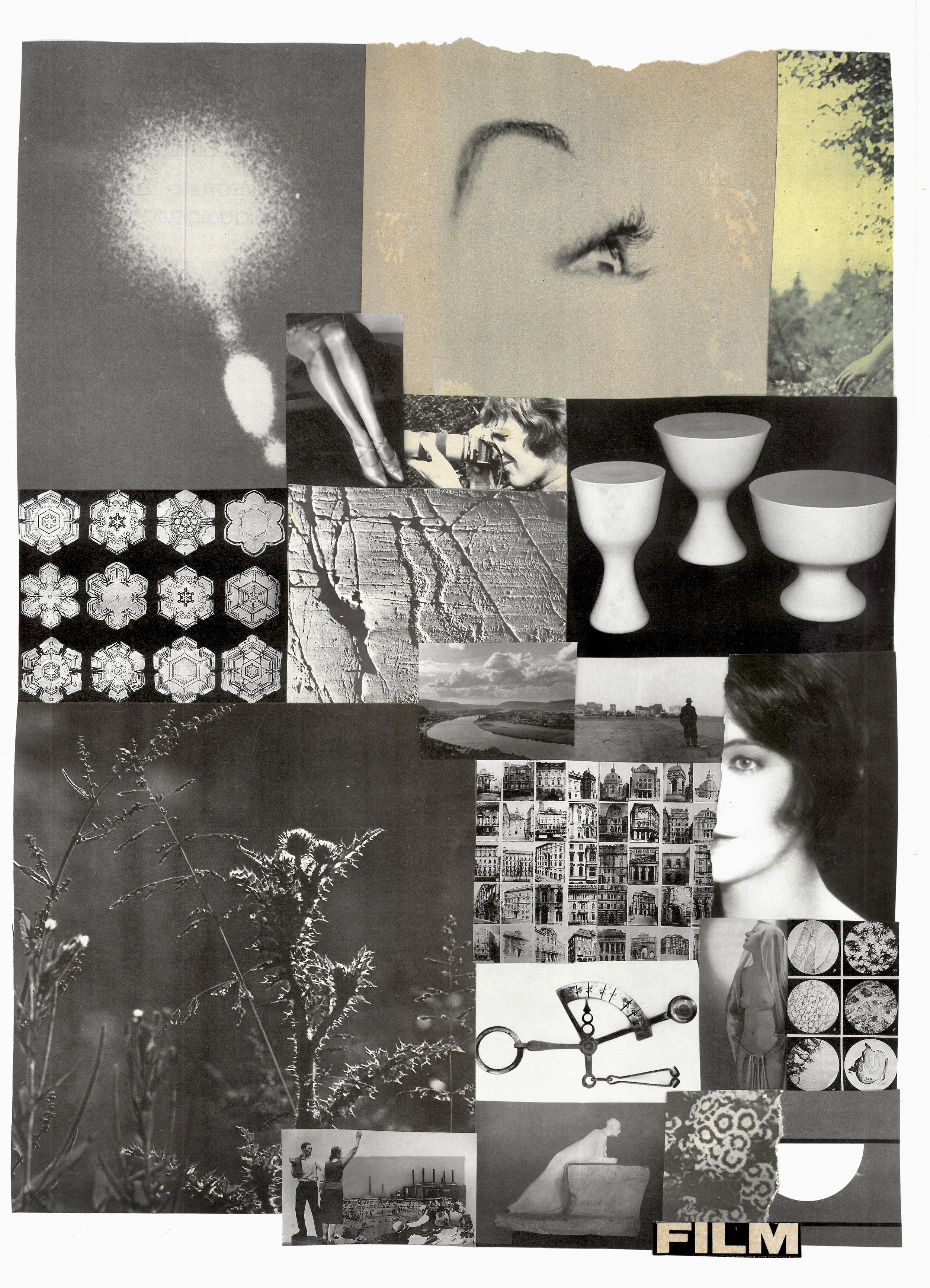
No.2 - all over
Utilizing an "all-over" compositional technique, this collage achieves a rhythmic visual flow that eliminates a central focal point. Inspired by the fragmented, split-screen aesthetic of Man Ray’s cinematic work, this piece aims to synthesize the visual universe of all four films. It weaves together diverse source materials -ranging from outdoor landscapes and floral motifs to rayogram-inspired patterns, objects, and fragments of the female body- into a singular and cohesive composition.
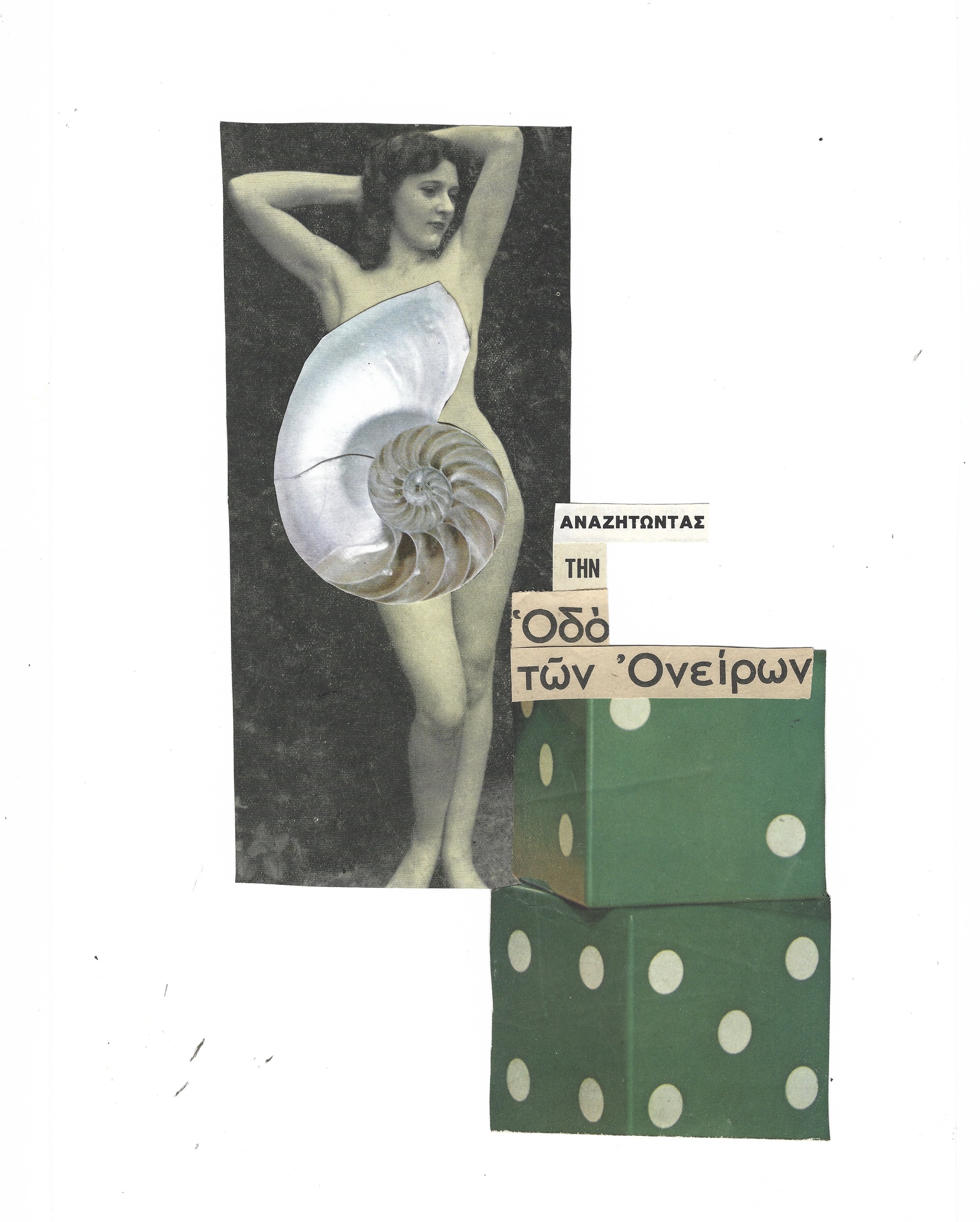
No. 3
In this collage, the female body is treated not as a mere object of gaze, but as a vessel of latent eroticism. Central to the composition is the seashell -a deliberate substitution for the starfish seen in Man Ray’s 1928 film The Starfish. By obscuring the figure, the shell intensifies the tension between concealment and desire. The motif of the dice serves as a nod to The Mysteries of the Château of Dice (1929), introducing an element of chance and controlled uncertainty inherent to the Surrealist practice. The work is anchored by a poetic inscription, "In search of the path of dreams," a phrase inspired by the dream-logic and evocative intertitles that defined Man Ray’s cinematic storytelling.
Errika Deli is a visual artist whose practice centers around analog collage. She meticulously curates materials from vintage magazines, transforming them into intricate visual narratives that explore the intersections of feminism, poetry, eroticism, and literature. Currently residing in Greece, Errika is also pursuing her Bachelor's degree in Audiovisual Arts, further expanding her academic and artistic exploration. You can reach her through Instagram @analogfemmecollages or by email: errikadeli@gmail.com.
