Interview: Reading Anaïs Nin • A Living Archive
Being a fan of Anaïs Nin can sometimes make one feel isolated. For years her work has been pushed aside but thanks to the re-launch of The Anaïs Nin Foundation together with a number of readers and scholars taking an interest in her work – the online world has opened up a new channel of love for her work. One of those is the Instagram account Reading Anaïs Nin • A Living Archive.
Natascha says she is a reader and amateur scholar. She shares lush images of her wonderful book collection together with pieces of her writing on her love for Nin’s work. Curious about fellow Nin readers, I wanted to chat with her and dig a little deeper into her world and what a pleasure it was.
How did you first find Anais? And which book did you read first?
I came to Anaïs through reading Delta of Venus and Little Birds for the first time when I was in high school. This was back in the 1990’s, and I knew nothing about this woman other than the fact that she had a great imagination.
I didn’t know it then, but knowing now that the erotica she wrote for hire that made up these volumes was actually the work she was least proud of yet became so well-known for is fascinating to me. Her bio on the back of the book mentioned her diary, so I quickly got a copy of “Henry and June” to read next, and the rest, as they say, is history.
One of my best friends who was similarly obsessed and I used to just send each other passages or quotes from whichever diary volume we were reading to each other in the mail. I always had a volume of the diary in my purse. We would meet at coffee shops specifically to “read Anaïs.” When I went to Paris for the first time at 19 I went to all the cafes she mentioned in her diary.
I’m always reading multiple books at once, like a reading magpie, and there hasn’t been a time in my life since then that I don’t have at least one Anaïs book going -- either her own work, or a book about her work, or a book about her. So I guess you could say I was obsessed from the jump.
What inspired you to start the Instagram account?
I’ve been writing a book about Anaïs in my mind for like twenty-five years at this point, and as any artist or writer knows, those projects or ideas that stay with you and don’t let go are the ones we shouldn’t ignore.
But it’s this subterranean, deeply personal thing that I’ve been sort of feeling my way towards a manifestation of like I’m in a dark room for years and years. Starting the Instagram account was a side step that felt right in the direction of doing that long-form writing about Anais that has been simmering and evolving on the back burner in my brain all this time, starting to try to give it some shape, and just…starting.
Another reason was, as silly as it may sound, to just share my love and fascination and knowledge about this writer I’ve been low-key obsessed with for decades with people who are new to her work, totally unfamiliar with it, who love her too, or who have maybe judged her harshly.
I’m not shy about how I feel about the way she was portrayed in Diedre Bair’s biography (and in some other sources as well) and that it often amounts to high-brow slut shaming, in my opinion. In Bair’s case, I would also add the massive dose of the internalized misogyny carried by Bair herself that she projects on to her subject, which ultimately makes me sad for both women. In the 90’s there was substantial backlash against Anaïs, at least in the U.S., and Bair’s book had a lot to do with that.
It’s also impossible to deny that Anaïs would not have been judged in the same way, alive or dead, if she had been a man. This double standard was something that was really apparent to me even as a teenager when I first started reading her work, and it’s always really pissed me off.
There’s just worlds more to Anaïs than who she slept with, or the parts of her life that have been scandalized. I also firmly believe that there’s a much better understanding of the effects of trauma in 2026 than there has been at any other time in history, and that viewing the way Anaïs was historically judged through that lens makes it an even shittier thing to do to a victim.
What’s been really amazing about the Anaïs Instagram account is that I thought I was going to be posting a bunch of stuff about a writer nobody really knew about anymore, and that like five people would see it – and I was totally okay with that because for me it was really just about the process of starting to write about her. But that’s not exactly what happened.
It turns out that there are sooo many Anaïs Nin fans and readers all over the globe and a bunch somehow found the account, and being able to connect with other people who love her work has been really amazing. Newer readers are coming to her work with a more modern, less sexist perspective and that’s also been so, so awesome to see firsthand. I’ve had really cool conversations with people about her work who I would never have had the chance to cross paths with in any other way, and that’s despite the fact that I’m not the best at correspondence. This aspect of the page has been and continues to be the best, unexpected gift.
Do you have a favourite book of Anais’s? Least favourite?
I really can’t choose just one favorite, but I think she’s truly in her element as a writer in the diary. What I’ve often felt a bit sad about is how much she struggled with the acceptance of that type of writing for most of her lifetime. In retrospect, she was really pioneering the types of writing we now largely refer to as autofiction and memoir. I’ve always thought of her diary as more of a memoir than straight-up autobiography, and I don’t believe the latter was ever her intention.
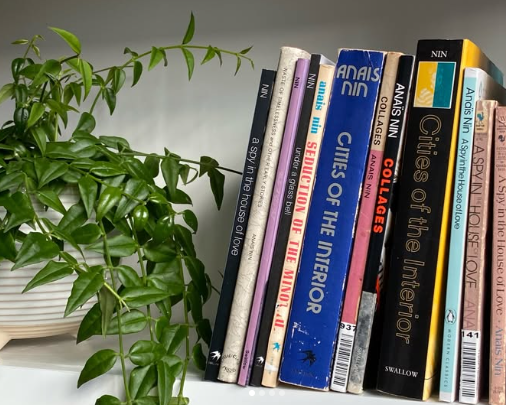
However, if you forced me at gunpoint to pick just one of her fiction books as a favorite, it would be “House of Incest.” That book is like a perfect explosion.
A favourite era, via the diaries?
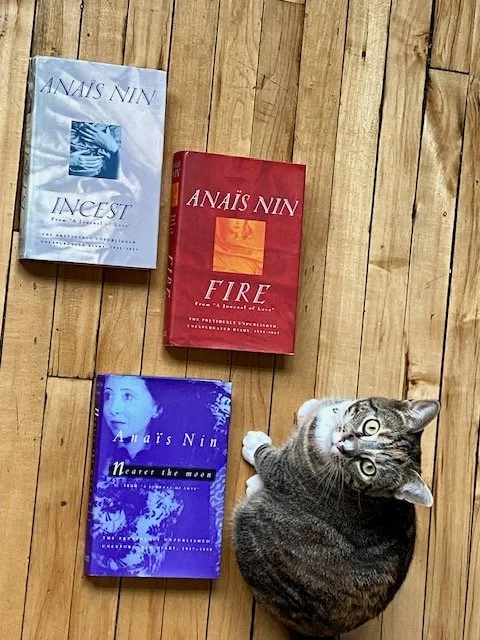
I think of them less in terms of different eras and more in terms of different editors, their different styles and approaches, and the different goals the different editors had in terms of the final books. So for me, the diaries are in four different mental collections: “The Diary of Anaïs Nin” volumes, “Henry and June”, the rest of the “Journal of Love” series (“Incest,” “Fire,” and “Nearer the Moon”), and the final volumes of the unexpurgated diaries that began appearing in 2013 (“Mirages,” “Trapeze,” “The Diary of Others,” and “A Joyous Transformation”). I love all the diaries, though they are definitely distinct and different reading experiences in my opinion.
This has also changed for me over the years as I’ve not only gotten older and gained perspective but have also gotten more experience as a writer and editor myself. When I first started reading Anaïs’s diaries I really had no idea what any of the different types of editors actually do, what the craft of editing is or what the editing process involves, and how integral it is to the final product, whether that’s a book or an article or a story. I didn’t know that more often than not, a writer and editor work together in a kind of partnership to create what we end up reading.
Back then I thought book editors mostly corrected spelling and grammar, and not much more, which is obviously not even remotely true. So if you’d asked me this question back in the 90’s my answer would have been “Henry and June,” which I totally believed at that time was a literal transcription of her handwritten diary -- I chuckle about that now.
You have a love for collecting books, where did this all start?
I’ve been an avid reader since I was a kid, and books have just been a huge fixture in my life for as long as I can remember, both the reading of them and their physical presence. The act of reading is something my brain literally craves the same way it craves movement or sleep. And I’ve also been writing since I was a kid, so words and books are just very elementally intertwined with everything in and about my life.
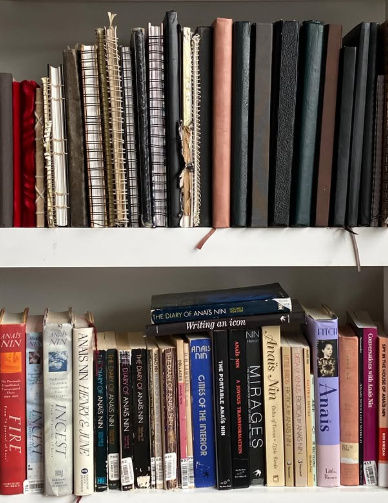
I’ve also moved a lot over the years, and so while I’ve done a few massive purges in an attempt to lighten the load, I can’t remember a time in my adult life that I haven’t needed at least eight feet of empty wall space for my books -- they’re like a huge permanent yet ever-changing piece of furniture at this point, and I can’t imagine not having lots and lots of books. In my next life, I will either be a librarian or a book hoarder.
The Instagram account – are your posting habits planned or intuitive?
The Instagram account is entirely intuitive and spontaneous. It’s also faceless and as lo-fi as possible on purpose. Social media isn’t my natural habitat and isn’t something I’m especially good at, and I actually avoid it in my personal time other than the Anaïs page because when I scroll I can viscerally feel what it does to my anxiety levels and attention span. I’m just really an analog girl at heart.
In previous professional roles, I’ve been involved with managing the social media presence of brands, and so I’m very cognizant of the professional side of social media and the skillsets involved in creating a polished page -- it’s a lot. And I don’t want the Anaïs page to ever feel remotely like a job instead of a fun creative project, so I kind of don’t plan much beyond “this could be an interesting post” or “wow, the light looks cool right now, let me take a picture.”
But I’m experiencing a bit of an existential crisis about posting as much writing as I have previously on the page because of AI.
As a writer, intellectual property and copyright are things I think and care about a lot. It’s one thing to write something for hire, either as freelancer or on staff at a publication -- you’re going into it knowing that you don’t own the final product, and that the copyright and intellectual property will belong to someone else, and that’s all established and agreed upon ahead of time.
But now, anything anyone writes and posts on the internet is being scraped by AI bots and will essentially be plagiarized in some form or another, so sharing writing on a platform like Instagram, or really anywhere on the internet that isn’t behind a paywall, is literally feeding it straight into the machine.
So when I write something that I want to post as a caption for example, I have to think about whether or not I’m okay with having this intellectual property literally stolen. I hate that that’s the new reality, and it’s definitely changed the way I write for the page. Which makes me deeply sad, both on a personal level and a macro level. So I think the writing portion of the project will evolve somehow, but I’m not sure which way it’ll go yet. Inspiration will let me know when she arrives.
In the interim, I’ve been thinking about ways to visually share my collection of Anaïs books more -- the “living archive” aspect of the account -- and how to do that in an interesting way. I love seeing people’s book collections, their reading mood boards, rare books that I’d never see otherwise, places I’ve never been, interesting bits of context, and so I’m kind of following what feels good to me to interact with when I do spend time scrolling. I also want to figure out ways that the account can contribute to the fostering of community around her work, the element of human connection of Anaïs readers to each other and the conversations about her that are authentic and happen organically. Lots of ideas swirling around, and I’m so excited about how it continues to evolve.
